My Website

My Website
Please click here to view my website

Front Cover Edition 1

Contents Page Edition1

Front Cover Edition 2

Contents Page Edition 2

Sunday, 4 November 2018

POST 6: MAGAZINE EDITION 1: COVER AND CONTENTS PAGE

Edition 1 Cover


For my first edition, the pose I intend for my model to use has been drawn for Fashion magazine a inspiration. I like how this pose will feature the whole of the model but it is a little different from a simple standing pose. I will follow the typical house style fashion magazines use of the larger capitalised masthead in the centre and text captions surrounding the model on the left and right of the for cover. I will use the same model for both my cover and contents pages since I have seen magazines do this before. To make sure readers will be able to get to the magazine website, I will put the website in the bottom left corner below the barcode. 

The model will be under high key lighting and shots will be taken in a studio. I have chosen to use a floral background for the cover. The makeup will be subtle with pink eyeshadow and black winged eyeliner to portray a soft look.


Below is the shoot schedule for this edition's front cover and contents page:


Here is the final product:


At first I did not include my tagline because it is not conventional to place a tagline on a front cover but along the spine but my teacher suggested I should so I placed on the left below my title. For contents page I was encouraged to slightly alter some listed articles to make more appealing to my target audience.

POST 5: PROPOSAL/RESPONSE TO BRIEF

I have decided to name my magazine Bespoke and its tagline is 'born to be different'. My magazine is predominantly aimed at women between 16-25 of class AB with a view to embrace and not exclude minorities and have diversity in terms of ethnicity, disability and age, it is a magazine promoting freedom of self expression, female empowerment and feminism. The content is mostly fashion related but other genres include beauty and lifestyle as well as celebrities and news.


Print

In print, the title Bespoke, will lie in the centre of the cover in bold and capitalised, the issue number will lie in the top left corner and my tagline will be directly below the masthead, on the left. Typically one female model is placed on a single fashion issue so I will implement these conventions. I intend to make sure to also use at least two different social groups and a minimum of four original images over my covers and contents pages. For convergence, the website of the magazine will be featured in the bottom left corner of the front cover below the barcode. The month of the issue and cover price will be located on the right below the masthead as well. To retain house style, I will apply the same layout across both covers and both contents pages and use the same fonts. 

Related image


Website


Firstly, I would include the title of may magazine, Bespoke, to the top left corner like Grazia and add a search tool buttons at the top of each web page saying 'news', 'fashion' and  'beauty' for example. For my website I will take inspiration from Elle with an audio-visual advertisement banner and stylise my website in a similar form to the fashion magazine's website, I will opt to use a black banner inspired by Grazia while the rest of the web pages will remain white. Additional influences for my homepage and its layout include Harper's Bazaar. My second web page will be inspired by Elle's 'The Best Little Black Dresses To Buy Now' article as it features a gallery slideshow of dresses and their links to buy them, i would like to implement the same to my second web page but with an article on shoes. all my links will be active, taking my website users to another page. To get to my magazine's social media (Twitter an Instagram) from my website, I will utilise their respective icons. 


The values and attitudes my magazine hold will feature across all its platforms: print media, website and social media.


The name of my independent production company is Compass Point Studios, I decided on this name because it promotes its audience to follow what they love such as fashion. For my logo, I used four triangles to represent four points on a compass and I used a monochrome style communicating classic simplicity. 


POST 4: REPRESENTATION

While doing my research I decided to focus on ethnicity and the differences between magazine covers featuring white and Caucasian people and black, Asian and other ethnic minorities since I would like to focus on that aspect for my magazine. The main convention to note is that magazine covers of women's magazines rarely feature men since there are women's magazines for target audience (women).


The first moodboard features many well known people such as models: Kendall Jenner, Georgia May Jagger, Cara Delevingne and Suki Waterhouse as well as singer-songwriter Taylor Swift. In one particular Kendall Jenner is the face of Harper's Bazaar Summer Beauty Issue while actress Jennifer Lawrence is depicted as an American Beauty, this is the cover of the September 2017 issue for Vogue, September is regarded as the most important cover of the year. This is focus on beauty of the women in this moodboard with another actress, Naomi Watts being named 'Pretty As A Princess'.


In this moodboard, there is more of a range of diversity with black singers Beyonce and Rihanna. Indian actress Priyanka Chopra also appears in this moodboard in addition to actress and singer Jennifer Lopez and Canadian model Winnie Harlow who has vitiligo, a skin condition. In my research I noticed that famous people from a minority background tend to appear more in overseas magazine than British and American magazine covers for example Rihanna's Harper's Bazaar China of April 2015 cover. An was a Harper's Bazaar Arabia cover with models, all of minority backgrounds with different skin tones appeared in the middle of the savannah. This contrasts with a different group shot of five models with only one person of a background other than white featured in a Vogue issue, the female model positioned to be sitting on the ground unlike the model either standing or sitting on seats could be a metaphor for the reflection of the magazine's view (or the photographer's) of people in society when all people of different races should be treated equal.


The September Issue


In the magazine industry, the September issue is considered the most important issue of the year. One of these reasons is because the September issue has the biggest shopping guides. The people featured on the September issue usually have something like a film or album to promote and are at the top of their industry, by being on a September magazine cover, this tells the industry that these people are the ones to watch for that year. Above, last year Jennifer Lawrence on her own in four separate magazine covers and is captured as an 'American beauty' in her first cover on the left. Lawrence appears as a elegant woman, innocent and natural lady, a glamourous bombshell and a work of art. Constant references that a slim white female is the beauty ideal affects other audiences and provides negative perceptions of other ethnicities. However, in this year this presentation of representation has broken down, the idea that black women do not sell in terms of magazines has changed. The September issues of 2018 of well-known magazines such has Vogue, Elle and Porter have used women of colour as individuals on their cover issues. This is a significant demonstration of a world that knows some things should change like a larger variety of women of all ethnic backgrounds should appear on magazine covers. Theorist bell hooks recognises that feminism is a struggle derived from patriarchal society and certain women in society are oppressed more than others due to their class and race. The values, attitudes and beliefs of a magazine are strongly represented on their cover and should present a more wholesome view of society. Media theorist Gerbner argues that consist representations of ideas over a long time period can sculpt and impact the audience's outlook.


In the spirit of diversity, one of Grazia's weekly September issues had two covers demonstrating diversity in disability on one cover and age on the other. The models ages' range for the cover on the right from 26-63 and the left cover features five empowered disabled women with 'frustrating experiences' who feel 'alienated by the fashion industry'.  The editor of Grazia, Hattie Brett said: " Grazia has a long standing history of celebrating diversity in fashion. We wanted to dedicate this Big Fashion issue to 11 women changing the face of fashion with their messages about inclusivity and visibility". Though both covers are acknowledged for their diversity in age and disability, there is underlying diversity of ethnicity too.

Generally clothes on fashion magazine covers ten d to be very expensive glamourous pieces coupled with elaborate, striking makeup, all lighting is high key and normally models featured on the covers are successful singers, actors, models or some other type of celebrity. Props are usually limited to chairs and stools but can be props like a swimming pool.


In terms of fashion, there are many elements that come into play to make up the fashion industry. There are many media distributors of fashion magazines but there are also individuals that express their interests in fashion through social media and the internet some of who are fashion bloggers and followers.

Some examples of famous unique fashion bloggers


Gabi Fresh

Gabi Fresh is a promoter of body confidence as someone who is plus size. She has found her place on Instagram and has over 600,000 followers on this social media platform. Holding her own website gabifresh.com she posts blogs on life, fashion and beauty and expresses fashion pieces she likes to wear.


Chiara Ferragni

Ferragni otherwise known as The Blonde Salad is a prominent figure on Instagram boasting over 11 million followers. She is an Italian influencer fashion businesswoman and was named Most Powerful Fashion Influencer in 2017 by Forbes.


Leandra Medine

As the founder of Man Repeller created in 2010, Medine has produced a company that explores the idea that 'an interest in fashion doesn't minimize one's intellect'. The business likes to challenge conventional notions of beauty and high fashion.


POST 3: CODES AND CONVENTIONS

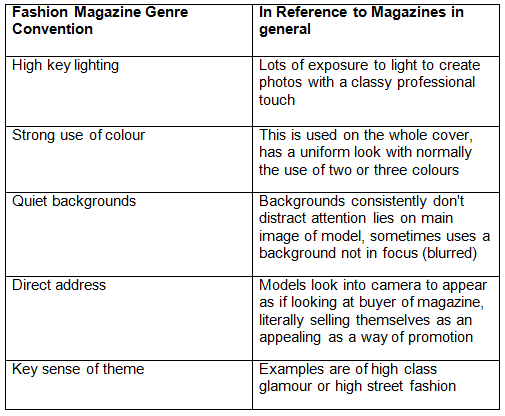
Fashion Magazine Cover Conventions


Example of Magazine Cover

In this June 2016 cover featuring singer Selena Gomez, the audience can gauge that the theme is high glamour as she is dressed in expensive attire subtle makeup and stylised hair. Gomez is connecting with the target market with her eyes looking into the camera projecting direct address. There is a strong colour scheme of red and white consisting of predominantly red in the typography of the masthead 'Marie Claire' and caption 'red hot summer style' matching her black and red outfit while the other captions are white in colour. The background is kept plain in order not to distract the readership from the main image of the singer. The photographer of this cover has used high key lighting as the cover issue shows areas of light and faint shadows on Gomez's face, right arm and shoulder. Typical magazine front covers have white females grace their covers, this dominant representation can be an issue to audiences when this is projected as the beauty ideal, provoking many readers to interpret this with a negotiated or oppositional reading instead of the dominant or preferred reading magazines want readers to have. 


Magazine Issues


Fashion magazines frequently name their covers with on vartious topics, topics range from fashion related issues such as the big fashion issue by Harper's Bazaar and the ageless style issue by Vogue to non fashion related issues like the math issue and the sisterhood issue by Fashion and Elle respectively.


Typography

Serif and Sans Serif Typefaces

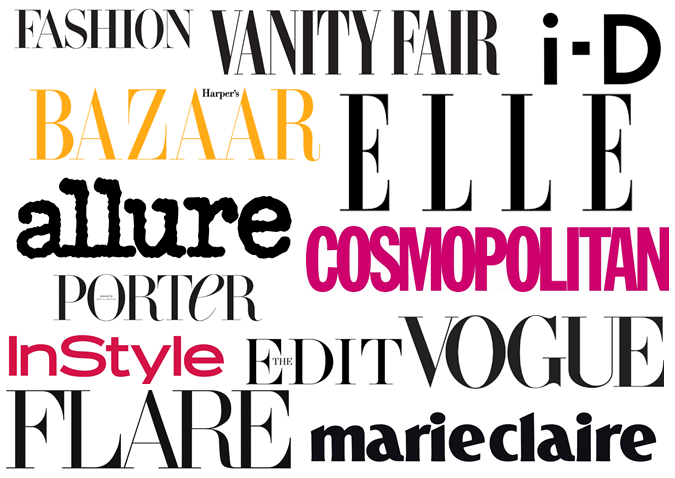
The definition of a typeface is a family of fonts. Serif typefaces utilise small typefaces known as serifs, these typefaces tend to look more traditional than sans serif typefaces that look cleaner and contemporary. Fashion magazines like Vogue, Harper's Bazaar and Vanity Fair use fonts that appear formal projecting the magazine's importance and how they are very established. In recent years, Vanity Fair changed the font of their masthead from their previous typeface to have a more authorative impression.Others such as Cosompolitan, InStyle and i-D use slightly more modern fonts that showcase simplicity and could be a
 reflection on the fact that their magazine is easy accessible to their audience. Looking at these fonts used, I have noticed that mastheads for magazines don't tend to look particularly fancy since the magazine's masthead needs to be legible for the readership. 


Contents Pages


Webpages


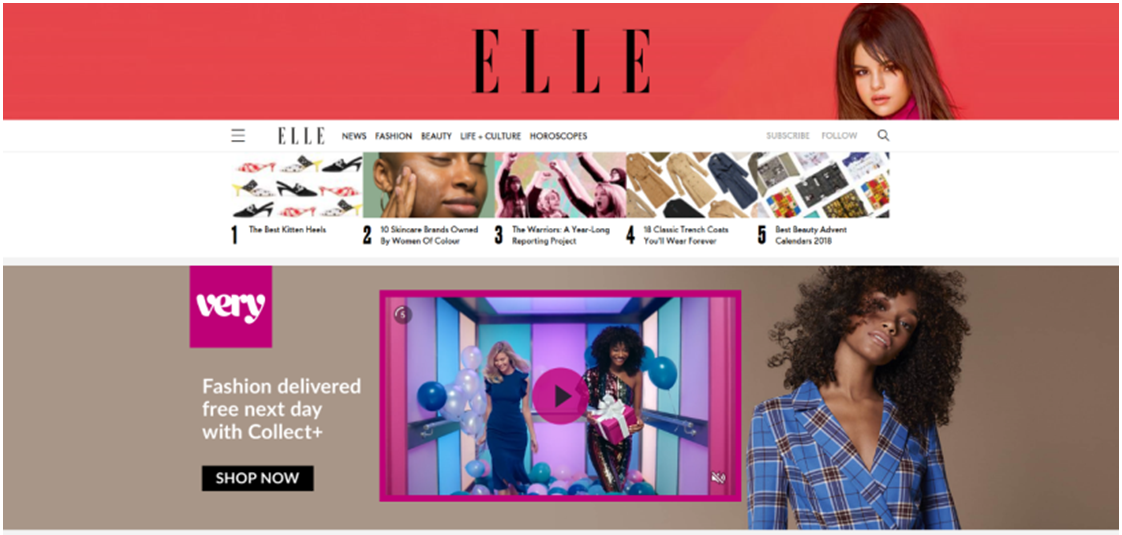
Elle magazine has a strong sense of brand identity since the first thing that can be seen on their homepage is their brand name on their banner with an image of Selena Gomez (the face of Elle's October issue) on the right. Their additional subheadings are: news, fashion, beauty, life+culture and horoscopes, showing the hierarchy of the topics the magazine covers. An advertising video promoting purchasing of products by Very is relevant to the Elle’s audience of predominantly woman of class AB who enjoy reading about fashion and fashion related news and culture. The primary images for the articles at the below the heading and masthead have been created in a linear format. Scrolling down the homepage, more articles are provided with larger images in with accompanied article names which are capitalised and subtext. The articles also include the names of Elle’s writers such as Olivia Lidbury. Articles cover a range of genres such as fashion, beauty and culture for example Japanese culture in the one of the articles above. Another advert has been alongside another advert for perfume, Les Parfums by Louis Vuitton.
Social media links such as Facebook and Twitter are easily accessible to enter Elle's social social media pages and encourages their readers to comment, like and share.  


POST 2: INDUSTRY

Bauer Media

Bauer Media Group founded in 1875 is a European-based media company with headquarters in Hamburg, Germany. It owns over 600 magazines including fashion, lifestyle and entertain magazine Grazia. Additionally, it has ownership of over 400 digital products and 50 radio and television stations globally. The media group has a workforce of around 11,000 people in 17 countries. Its CEO, Yvonne Bauer is the fifth generation in the family ownership                                                          of Bauer.

Bauer Publishing

Bauer Publishing uses a tagline: 'we think popular', this is to represent what the majority of society from media forms such as magazines, expressing that it considers its audiences values and interests. It publishes the top two selling retail magazines: Woman's World lies first and First For Women is in second place. The market it targets are women as well as an audience interested in science and technology.


One of Bauer's better known magazines is Grazia, a weekly magazine targeted at women ages 25-45 of class AB with a focus on fashion, celebrities, beauty and culture. Describing themselves as 'brave, bold, innovative', the magazine takes a different approach to mainstream magazines like Vogue by including inserts on the cover of clothing and celebrity gossip stories. As my magazine audience are of a lower age bracket of 16-25, this would not lead to competition in readership. Since Grazia has a higher focus on human interest and celebrities than my fashion magazine, the magazines will not be competition with each other, again, over readership. Now featuring a Grazia Playlist section, it has 'everything in the week's cultural drop- from podcasts and books through to  music, travel and interiors' and for its readers that prefer non-print, it has a online magazine site called Grazia Online. Grazia consistently places its masthead in the top left corner utilises the same fonts. In this particular issue, its colour palette is predominantly purple, yellow and white, this magazine constantly uses an array of images of celebrities and clothing across its front cover as well as a focal image.  


Human Being Magazine

An example of an independently produced magazine is Human Being. It is published by a Virginia-based clothing and lifestyle store Need Supply. Distributed through Bryony Lloyd, the managing director of Antenne Books, it is a lifestyle and style magazine with a primary focus on fashion and culture. As an independent magazine, its core audience is not mainstream but niche and the layout and style of the magazine does not follow its genre codes and conventions. The distribution of this magazine will be more limited than well-known magazines like Harper's Bazaar and Vogue meaning it can only be bought from larger chains like WHSmith and Sainsbury's rather than from  the local corner shop.


Though it may seem like magazines earn the majority of their revenue from their cover price, this is not the case. Most of the revenue is derived from brands promoted throughout their magazine and online media through advertisements, it is crucial that magazines at not too niche, very niche magazines target a minor amount of society so magazines to need to ensure their readership remains relatively high in order for more brands to pay to advertise in their magazine.


Advancements in technology has created social media platforms like Twitter and Instagram to like, comment, share and follow. To retain its engagement with its readers, magazines have opened up to the usage of social media and update their followers with photos and tweets as well as granting their readers the chance to share their magazine articles from their website to different social media platforms.

Regulation of Independent Magazines in the UK


In the UK, the independent regulator of magazines (and newspapers) is the Independent Press Standards organisation (IPSO). They hold 'newspapers and magazines to account for their actions, protect individual rights, uphold standards of journalism and help to maintain freedom of expression for the press'. 

The IPSO do a number of things including:

-Making certain that member newspapers and magazines follow the Editors' Code
-Investigating complaints possible breaches of the Editor's Code from printed and online material
-Forcing magazines and newspapers to publish corrections or adjudications if they breach the Editors’ Code (this include the cover page)
-Monitoring press standards and requiring member newspapers and magazines to submit an annual statement about how they follow the Editors’ Code and handle any complaints
-Investigating serious standards failings and can fine publishers up to £1 million in cases where they are particularly serious and systemic
-Operating a 24-hour anti-harassment advice line
-Training and guidance provision for journalists in order for them to uphold the highest possible standards as well as advice for journalists and editors
-Providing a Whistleblowing Hotline for journalists who feel they are being pressured to act in a way that is not in line with the Editors' Code
-Working with charities, NGOs and other organisations to support and improve press standards

From funding through the Regulatory Funding Company (RFC) which is paid for by member publications, the IPSO is entirely independent, segregating itself from its member and executing work separately.
The Editors' Code of Practice focuses on: accuracy, privacy, harassment, intrusion into grief  or shock, reporting suicide, children, children in sex cases, hospitals, reporting of crime, clandestine devices and subterfuge, victims of sexual assault, discrimination, financial journalism, confidential journalism, confidential sources, witness payments in criminal trials, payments to criminals and the Public Interest.

Monday, 24 September 2018

POST 1: AUDIENCE

The audience for my brief are culturally sophisticated, class AB and are between 16-25 years of age.

Cultural Sophistication

People who are culturally sophisticated are those who use abstract ideas to comment on their experiences. The definition of being sophisticated is 'having, revealing, or involving a great deal of worldly experience and knowledge of fashion and culture'. 

The classification of people within the UK are broken down into categories: A, B, C1, C2, D and E with the class with the people with the highest earnings.

A
These people are in the upper middle class who are considered to have higher managerial, administrative or professional occupation. 

B
This is a middle class demographic where people are classed as having intermediate managerial, administrative or professional jobs.

People aged 16-25 are considered an audience that spends money. They are big social media users with 97% using Facebook and 45% using Twitter. Many in this age category are students that contribute to approximately  £20 billion a year the UK's economy and account for roughly half the youth population of the UK. This means that students are large spenders of money and therefore appeal to them I would make my magazine's price appropriate in order for to be able to afford it. My magazine would mainly target women since women control over $20 trillion in worldwide spending in addition to studies showing that women read more than men so they are more likely to buy magazines.


My primary audience are culturally sophisticated class AB demographic here is an example:

Customer Profile

Kayla is a 22 year old female student studying fashion design. She likes to wear casual clothing and reading fashion magazines like Harper's Bazaar and Elle. She has more than one ethnicity and she likes to express her different cultural backgrounds in what she wears, she has noticed that the magazines she reads and other magazines rarely tend to represent various ethnic minorities so she would like to read magazines that project variety of people from minority cultures to reflect people in society and to educate her more. 

Secondary and tertiary audiences are not part of my target audience but are still interested in fashion magazines.

Customer Profile

Jasmine is in an age bracket older than my target audience (she is 34 years old), however, she is a huge fan of fashion. When she came to England as a teenager, she found that she had a lack of confidence in herself and felt lonely since she was one of few Asian people in her class and when she turned to the media, she did not see people who look like her. Now, as a mature women, she wishes that the magazines she reads would have more accurate representations of our diverse contemporary society.


Wednesday, 18 July 2018

End of Year NEA Task

End of Year NEA Task


Above is my finished magazine front cover for my NEA project on the fashion magazine brief on diversity.


1. What you have learnt since starting the mini-NEA on 18th June?

While doing this mini-NEA project, I have gained a variety of skills along the way in performance and studio training and web design. Utilising research, I have acquired some knowledge on magazine conventions and have tried to emulate some in my magazine cover.

The tutorial on building a website through WIX opened me up to the site I have never used before. I found it easily accessible and a quick and easy way to create a professional site without the need of having to go through an extremely detailed process of a website buidling course for example.
  
Through performance and studio training, I was encouraged to take myself less seriously which made me find myself more at ease as the performance sessions progressed. The studio training was really informative and helpful when I used the equipment for my photoshoot on Monday 9th July.

In hindsight, I would have probably done more research for my project to have a larger amount of ideas and more inspiration. 


2. What you have achieved for your NEA so far?

Now I have completed the process of creating my magazine front cover, I have found I am more accustomed to using Photoshop now and am able to do things using the software at a faster pace. For my photoshoot, I produced a shootboard so I knew the order and the timings of my shots. During pre-production and planning, I made moodboards, one that reflected the general representation of people I wanted to include in my magazine as the main cover image and features and another moodboard on positions. I had to put together my outfit for my photoshoot and decide which positions I would use in my shoot.


3. What your future plans are for your project?

Looking forward, I want to carry on with the project I am working on at the moment which is the fashion magazine brief and I will most likely use the same magazine title too. Though I see this mini-NEA project as learning curve, in September, I will probably continue to work on this project but I would like to produce of more material in terms of photography for cover images and features, this would presumably happen in the studio. Over the summer I would like to take location shots predominantly around London to use as locations in the backgrounds of my features and cover image.